
Nimi Jataka
Nimi Jataka
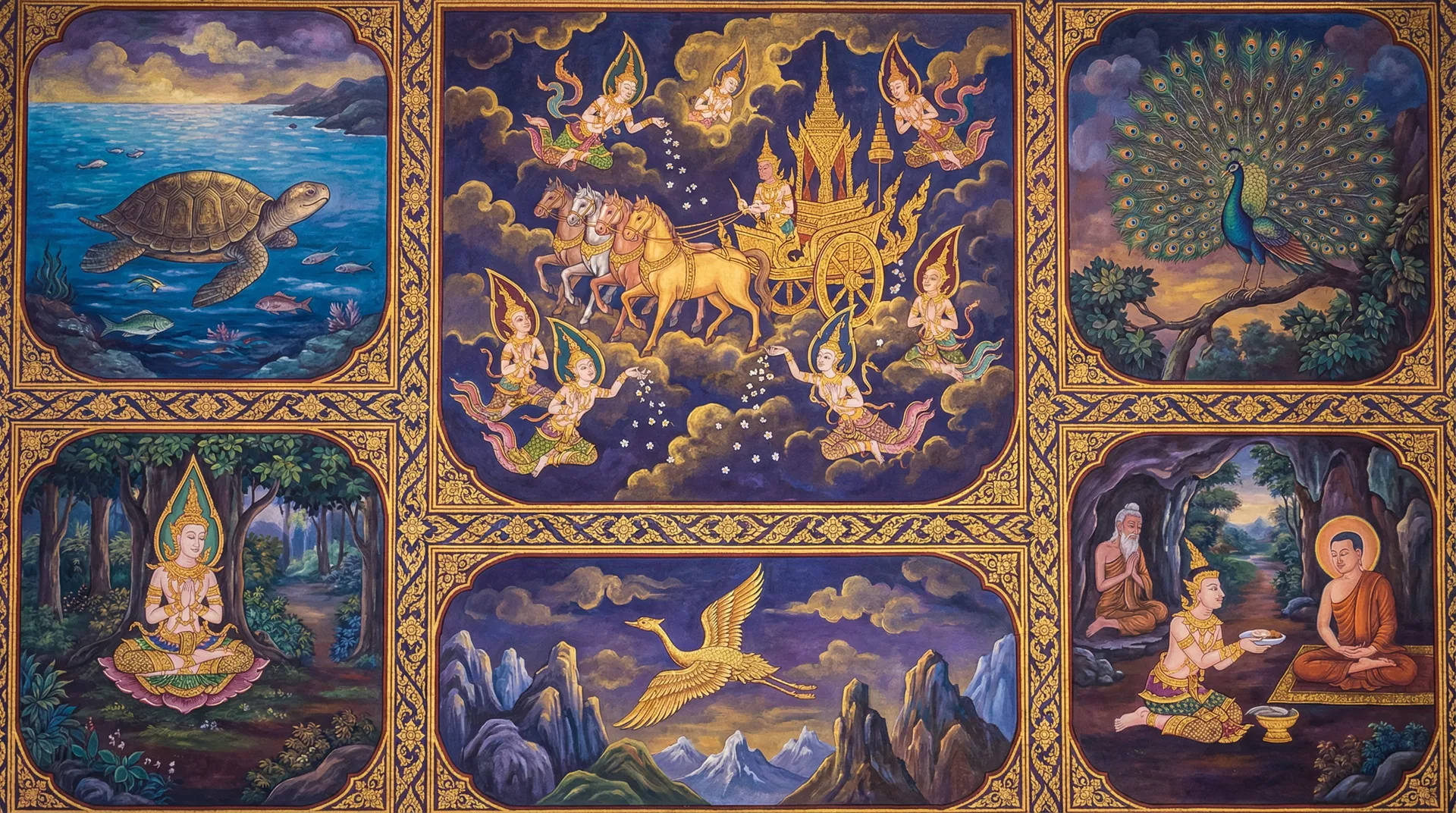
In the glorious city of Mithila, ruled the wise King Nimi. His reign was a beacon of righteousness, his heart filled with compassion and justice. One day, the great god Sakka, ruler of the Tavatimsa heaven, descended to the mortal realm. He found King Nimi meditating on the virtues of generosity, morality, and wisdom, his mind serene and focused. Impressed by the king's profound spiritual development, Sakka, in his divine form, appeared before him.
"O King Nimi," Sakka's voice resonated like celestial music, "your devotion to the Dharma is truly commendable. I have a proposition for you. I wish to invite you to my celestial abode, Tavatimsa, to witness the glories of the heavenly realms and to share in the merits of the virtuous. You shall be my honored guest."
King Nimi, ever eager to learn and grow, accepted the invitation. With Sakka's divine guidance, he ascended to the heavens. Tavatimsa was a spectacle of unparalleled beauty. Glistening palaces, adorned with precious gems, rose towards the heavens. Celestial beings, radiant and joyful, moved with grace. The air was filled with the sweet scent of divine flowers and the melodious sounds of heavenly music.
Sakka, with great pride, showed King Nimi the wonders of his domain. They visited the celestial gardens, where trees bore fruits of unimaginable flavors and colors. They witnessed the divine dances and listened to the heavenly choirs. King Nimi was mesmerized by the sheer opulence and bliss of the Tavatimsa heaven.
However, as they explored, King Nimi's keen mind began to observe. He saw that even in this heavenly paradise, there was an underlying impermanence. The celestial beings, though radiant, were bound by the cycle of rebirth, their happiness dependent on their accumulated merit. He noticed that their joy, while immense, was still a fleeting experience, destined to end when their karmic energy depleted.
One day, while observing a celestial being enjoying a moment of profound bliss, King Nimi turned to Sakka and asked, "O Lord of Gods, this place is indeed magnificent, and the happiness experienced here is beyond compare. But tell me, is this bliss eternal? Do these beings never experience suffering?"
Sakka, with a gentle smile, replied, "King Nimi, this is the highest form of happiness that beings can attain through their good deeds. However, like all conditioned phenomena, it is impermanent. When their merits are exhausted, they will eventually be reborn in lower realms. True, lasting peace, a state beyond suffering, is found only in Nirvana."
This revelation deeply impacted King Nimi. He realized that even the most exquisite heavenly pleasures were ultimately transient. His heart yearned for a more profound, unshakeable peace, a state of liberation from the cycle of birth and death.
Upon his return to Mithila, King Nimi's perspective had fundamentally shifted. He continued to rule with righteousness, but his focus now turned inward. He began to practice deep meditation, seeking the cessation of suffering and the attainment of Nirvana. He understood that true happiness was not to be found in external pleasures, however divine, but in the purification of the mind and the eradication of defilements.
He established monasteries and encouraged his subjects to cultivate wisdom and detachment. He himself dedicated his life to spiritual practice, tirelessly striving for enlightenment. His reign became even more renowned, not just for its justice, but for the profound spiritual wisdom that emanated from its king.
The story of King Nimi's journey to Tavatimsa and his subsequent quest for ultimate liberation became a legend, inspiring countless beings to look beyond worldly pleasures and seek the enduring peace of Nirvana. It taught that even the greatest heavens are merely temporary abodes, and the true goal of spiritual practice is the transcendence of all conditioned existence.
— In-Article Ad —
💡Moral of the Story
Even the most glorious heavenly realms are impermanent. True and lasting happiness is found in the liberation from suffering through the attainment of Nirvana, which requires inward cultivation of wisdom and detachment.
Perfection: Wisdom (Panna)
— Ad Space (728x90) —
More Jataka Tales You May Enjoy
 525Mahānipāta
Mahasutasoma Jataka
Mahasutasoma JatakaIn the vibrant city of Savatthi, the Bodhisatta was once born as a prince named M...
💡 Unwavering adherence to truth, when guided by wisdom and compassion, possesses the ultimate power to overcome deceit, malice, and conflict, even at the cost of great personal sacrifice.
 387Chakkanipāta
Sutasoma Jataka
Sutasoma JatakaIn a kingdom nestled between whispering mountains and a shimmering sea, there lived a...
💡 Wisdom and compassion are more powerful than brute force. True liberation comes from understanding and overcoming ignorance.
 141Ekanipāta
Mugapakkha Jataka
The Tale of the Mute Prince In the ancient kingdom of Mithila, ruled a just king named Dhanañjaya. H...
💡 True leadership is demonstrated through actions, courage, and compassion, not merely through eloquent speech.
 227Dukanipāta
Sutasoma-jātaka
The Tale of Prince Sutasoma In the magnificent city of Indapatta, ruled a king named Pāṇḍu, a man wh...
💡 True generosity lies not in giving what is easily spared, but in offering what is most precious, with a pure heart and without expectation of reward. Selfless sacrifice, driven by compassion, can overcome even the most dire consequences of past actions.
 401Sattakanipāta
Nimi Jataka
Nimi JatakaLong ago, in the ancient city of Mithila, ruled a just and virtuous king named Nimi. His ...
💡 True joy and lasting happiness come from living a life of righteousness and virtue, free from attachment and clinging to desires and outcomes.
142EkanipātaKusa Jataka
The Tale of Prince Kusa and Princess Pabhavati In the magnificent city of Kosala, ruled King Okkaka,...
💡 True beauty lies not in physical appearance, but in noble character, kindness, and virtuous deeds.
— Multiplex Ad —